The Patricia Deadman Project
Since April 28th, 2026, the ECH has been honoured to have worked closely with the estate of Patricia Deadman (1961-2024). Sixty-one photographs by Patricia have now been gifted to her friends and colleagues across Canada. This project includes photographs taken by Patricia in Canada, Mexico, and Europe, texts by Ron Benner, Cassandra Getty, Kelly Greene and Roberta Grosland, and additional comments from recipients. This project has been coordinated by Ron Benner with the support of Blessy Augustine Roberta Grosland, Jamelie Hassan, and Mireya Seymour.

Banff, Alberta
|

Paris, France
|
Merida, Yucatan
|

Southwestern, Ontario - change this photo
|
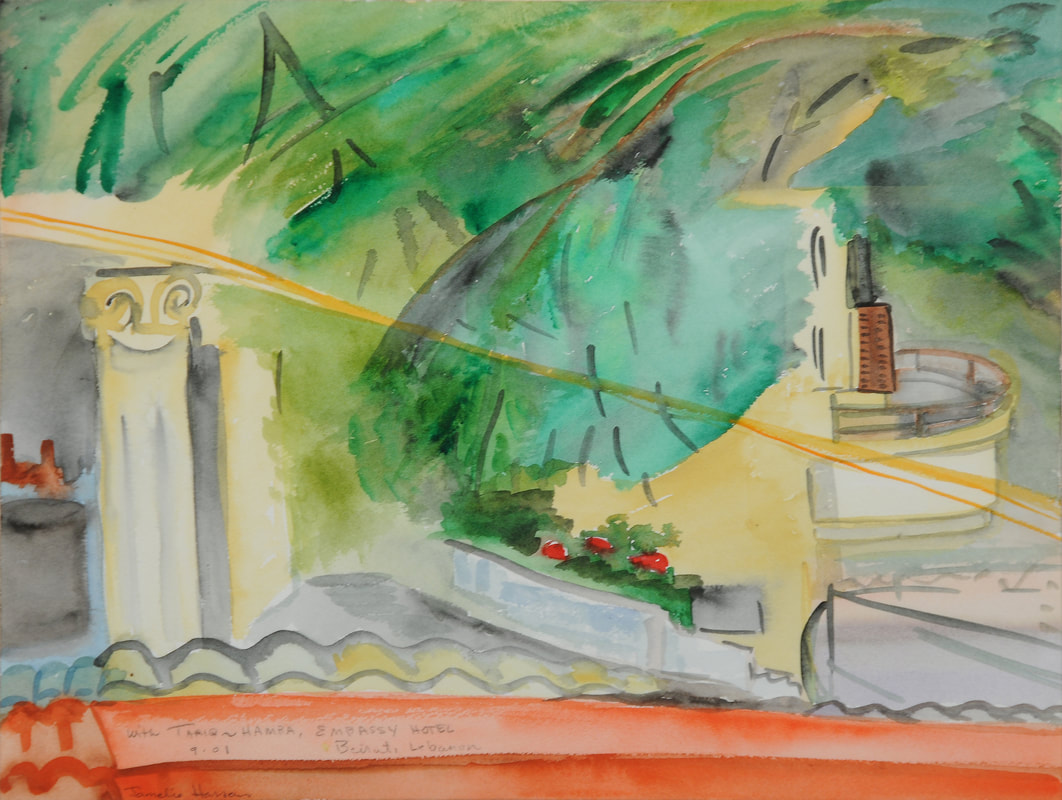
Ron Benner, Embassy Cultural House

|
Tribute to Patricia Deadman by Ron Benner
Delivered at the Woodland Cultural Centre(WCC) for the memorial gathering on March 2, 2025 I am an independent visual artist/activist and gardener based on the banks of the Deshkan Ziibi. At the time I sat down to write this tribute for Patricia, I wanted to acknowledge our history and friendship of over forty years. In 2020 during the pandemic, when the Embassy Cultural House (ECH) was re-invigorated by Tariq Hassan Gordon, I contacted Patricia to contribute to our programs. She had participated in many exhibitions over the years and was happy to connect with our ECH programming and publications, Pandemic Gardens: Resilience Through Nature and Intercambio. At this time, Patricia was also the curator at the Woodland Cultural Centre (WCC). I approached her to arrange ECH delegations to have visits and tours of the collection and exhibitions at WCC. I thought it was important that the ECH team and the interns from Western University's Department of Visual Arts were provided with a history of Southwestern Ontario through an Indigenous perspective on the history, materials and contemporary cultures of the Six Nations of the Grand River. It was a priority for those who were part of ECH to realize that the history of SW Ontario was absolutely not the sole history of European settler colonialism.WCC curated and presented events and landmark exhibitions of this Indigenous history spanning thousands of years of journeys, horticultural innovations and brilliant cultural production. Patricia Deadman was the perfect person to relay this knowledge to ECH's interns and other cultural workers. For the majority attending, it was their first visit to the WCC. I first met Patricia in the spring of 1989 at the University of Windsor where she was in her final year of obtaining a Bachelor of Fine Arts. At that time I was having a survey exhibition, Ron Benner: Other Lives at the Art Gallery of Windsor and the university asked me to give a slide lecture on my work. Among those attending, Patricia stood out, not only because of her height but because she asked me a dead serious question about the relevance of photography. Over the next 3 + decades our paths would cross and merge many times. Her knowledge of Mexico would be self-generated, like mine, with lengthy visits with the Mayans of Yucatan, the Nahuas of Pachuca, and the Zapotecs and Mixtecs of Oaxaca. Her understanding of history as a living entity would take her on photographic journeys across Canada, Mexico, Europe and Australia. Patricia was involved in all aspects of culture and visual arts projects. She was a photographic artist, a curator, a writer, an installer, a framer and a maker of relationships – both Indigenous and non-Indigenous. Her residencies at the Banff Centre for the Arts were significant and gave her the opportunity to use the darkroom to develop her negatives and print her photographs. She was the first Indigenous curator at Museum London in 1999/2000. In this capacity, we worked together on the Canada/ India project which included the London exhibition Dust on the Road: Canadian Artists in Dialogue with SAHMAT which brought artist/activists together through Hoopoe Curatorial in a touring exhibition. SAHMAT was a group of cultural workers in India working on issues of human rights. Bill Powless and Kelly Greene were among the artists included in this exhibition. When Patricia became the curator at the Woodland Cultural Centre she recognized that she was following in the footsteps of her friend and mentor Tom Hill. One of her exhibitions that she curated at the WCC was Thomas V. Hill: A Retrospective of an Artist (April 10 – July 21, 2021) and accompanying publication (WCC 2023). Both Tom and Patricia enjoyed eating at the same restaurant, The Sherwood in Brantford, a tradition we continue - to eat a classic hot turkey sandwich: turkey, mashed potatoes, sweet maize kernels and cranberries...all of which are native to the Americas. I left out the white, wheat bread – sorry – a recent contribution from Europe! |
Roberta Grosland, Estate Manager for Patricia Deadman
Kelly Greene
Cassandra Getty, Museum London
For four decades Patricia Deadman earned acclaim for her creative and insightful artwork, curatorial vision, and writing. Born in Ohsweken, Ontario, in Six Nations of the Grand River territory, she exhibited internationally from the mid-1980s until 2022. Her art was referenced in scholarly publications and exhibition catalogues, and acquired for collections across Canada, the United States, and in Europe.
Patricia (Pat) received a Fine Arts Diploma from Fanshawe College in London, and a BFA degree from the University of Windsor. I met her there in the early 1990s when she visited UWO’s School of Fine Arts for demonstrations and talks. I was fortunate to encounter her thought-provoking exhibitions at Museum London, the Woodstock Art Gallery, and the Woodland Cultural Centre, where she was a respected curator. I remember her support and humour in programs she participated in for Galeries Ontario / Ontario Galleries (GOG) including 2015’s Venice Biennale. It was a profound opportunity to see Patricia photograph manicured Italian gardens for her practice, and as a Tuscarora and Mohawk person, assess Venice’s role in the often-commodifying contemporary art world, and centuries of international trade, which supported centuries of colonialist harm.
Patricia shared insights into the complex cosmologies and histories of Indigeneity. She emphasized the diversity of the First Nations, unique traditions and interconnections, with respect, resilience and adaptation remaining, in her words, “embedded within a worldview that is in perpetual motion, as change is inevitable and is continuous.”
Patricia mesmerized viewers with her experimental photography. Processing her imagery by hand, she made her own rules: printing monochrome negatives onto coloured papers, or shifting photo paper under the enlarger to blur the forms of trees into maelstroms of scintillating pattern and movement. Patricia often processed black-and-white film using colour techniques, which resulted in broad areas of colour heightened to emphasize yellow, cyan blue, or magenta pink/red.
My favourite works are frequently Patricia’s Blanket projects. She arranged photographs of landscapes into grids, producing larger configurations of imagery that transformed nature into the abstract patterns of Indigenous blankets. These works combine human creativity and ingenuity with the beauty and bounty of nature, which feeds not only our imaginations but enables all earthly life.
Patricia travelled Canada and Mexico, photographing vistas that were significant to her, rather than those designated by park staff. Indigenous perspectives on nature and culture—from vegetation to ceremonial regalia—appear in her work, as does the impact of colonialism. In such series as Paris Gardens (2007) she recorded the severe topiary styles of France and Italy, the tight control of the land paralleling wider elements of forced assimilation.
Patricia brought wonder and understanding to people through her art and mentorship. She also curated at Toronto’s Power Plant, and the MacKenzie Art Gallery in Regina, Saskatchewan. Museum London displayed her art several times, including in 2007’s Ground Cover, 2015’s Reading the Talk, and 2020’s Resolution. A member of the Aboriginal Curators Delegation for the Sydney Biennale and other events, she continues to hold a special place in Canadian culture and in many lives.
Dianne Bos
Pat, I’m finding it difficult to write about you as though you are no longer with us on this plane, so I’ll address you directly. I know you’ll laugh out loud at this approach. You have such a great sense of humour.
We first met when you delivered a series of photos for a show I curated at the York Quay Gallery at the Harbourfront Centre in the late 1980’s. I don’t remember the exhibition title, but I do remember your work clearly. It was a series of prints that documented a walk you did in the mountains. A path through the trees. The sky visible in the distance between the tall pines. Each print similar, but getting closer to some unnamed destination. It was a movie made up of still images. If I could remember the title of the piece it would probably answer some questions.
We met then and hit it off. You, Pat aren’t a person one easily forgets.
The interesting coincidence was that over 10 years later we would be doing a walk similar to what you depicted, together up some very steep slopes in the Rocky Mountains. Or are they called the Selkirks there?
We were invited by Alan McKay, then curator at the Whyte Museum of the Canadian Rockies, on what was to be called ‘The Wheeler Hut’ expedition. The Whyte Museum had a programme of sponsoring artist’s expeditions into the mountains to create work that would be then shown at the museum. The invited artists were normally Albertan painters or drawers. Alan McKay decided to mix it up a bit and invite photographers and included us two Ontario artists along with three Albertan photographers and a poetry prof. Alan was the only person we both knew, and knowing Alan, we thought this could be fun. We were kinda forgetting that as Ontario’s we didn’t have a lot of mountain-climbing experience. So we both bought new ‘mountain climbing boots’ for the adventure. Yeah, without any real ‘break in’ period, the blisters we created were quite monumental. One of the goals one day was to reach the Illecillewaet Glacier. We were trailing really far behind the other artists who all had mountain hiking experience. Like, really behind. At one point I started thinking about bears. I jokingly asked you, Pat ,if you had any tips on avoiding bears. You know, ancient knowledge stuff. It was one of those dumb white-people questions. You burst out with one of your bellowing laughs and said ‘it’s best if we’re not the last people in the group’. Yup. We survived.
I had no idea what these mountain hut accommodations would be like until then. Women slept on one side of the top floor of the hut on a large raised plywood bunk on somewhat broken-in foam mattresses. No running water. An outhouse. Interesting. Pat, unlike me, you seemed to sleep very well. Driving back to Calgary after the expedition we passed through Deadman’s Flats. If you’ve driven out to Banff you know where that is. Of course, without thinking it through, I blurted out, ‘so is this where your people are from?’ Again, Pat, you kindly laughed and said first nations people would never chose to have the word ‘dead’ in their names. This was your adopted name.
The next stage of our friendship was in the darkrooms at the Banff Centre of the Arts. Now that I think about it we spent quite a bit of time in the dark together. I was working with a pinhole camera and colour film for the first time. You were working with film too. The Banff Centre darkroom facilities opened new directions for both of us artistically. I eventually moved to Alberta and worked as a photography facilitator in those very darkrooms and through that spent even more time with you in darkrooms. I remember having the wonderful experience of seeing some of your new work develop, Pat. In particular I remember the large colour pieces that you joined together into large grids to create almost snake skin patterns.
I’m sure you wont mind if I tell this story . . .. So when you’re printing in colour, the darkrooms have to be totally dark. No red safe lights like you see in the movies. So at the Banff Centre each of us had individual rooms with enlargers where we exposed the paper—but then you had to leave that room, travel down a dark hallway, and turn into another dark room where you fed the paper into the colour processor. The processing machine was really loud so you couldn’t really hear anyone else coming. We usually whistled or something to make our presence known. Not this time. Well, I was coming around the corner with my hands out in front of me so I wouldn’t bump into the wall and instead I bumped into you. My hands were exactly at your ‘boob’ level. You let out a very big whoop of laughter! It took us a long while to stop laughing.
So yes, Pat, you and I got very close.
I was really hoping we would have had time for more adventures Pat. We talked about you coming to France to do a photo retreat together with our mutual friends Sarah Fuller and Mary Anne Barkhouse. I wish it could’ve happened. It’s a reminder to us all. Seize the Day.
Sarah Fuller
Banff Connections: Remembering Pat Deadman
I met Pat in the late 2000s when I was working as the Photography Facilitator in the Creative Residencies Program at the Banff Centre. Pat was an artist in residence and as the Photo Facilitator, I was lucky enough to get a lot of opportunities to chat with her in between her sessions in the darkroom. I remember admiring her tenacity as she hand printed her Giardino dei Semplici series in the colour darkroom, where she use complex colour balances, and skillful dodging and burning techniques to bring black and white images of plants and landscapes into kaleidoscopic renderings of the land. She returned several times while I was working at the Centre and I last crossed paths with her in 2018 (I think) when I was in residence.
As a young artist, I felt lucky to chat with Pat about her experiences as an artist and she was generous in offering advice and feedback on the projects I was working on. I will treasure her kindness, her generosity, her immense talent and her sense of humour.
I moved away from Banff over ten years ago, but I happen to be staying at the Banff Centre this weekend, Oct 31, 2026. As I walked down the hallway to my room, I was struck by two beautiful large format images of mountain landscapes. One photo was a sepia coloured image of a burned out slope after a forest fire, and the second was a detailed images of mountain plant, printed with a slight cyan colour. They felt familiar, but also altered, and I took a closer look to see the artist’s name.
It was Pat’s work and immediately it felt like a visit with an old friend. The image of the plant was titled Indigenous Habitat and the image of forest fire was titled Where the Grizzly Bear Roamed. The didactic, written by Becca Taylor, described how Pat “captures the mood and atmosphere of a place rather than recreating a scene, sometimes manipulating the surface of the actual photograph to show the ambience of the experience.” I love this description of Pat’s work and in some ways, I think I may have picked up on this in the altered familiarity I experienced on first glance. It also reminded me about the power of and artist’s work, and how their vision lives on their artworks. It immediately took me back to Pat’s time at Banff and the discussions we had about art, the land, and the (sometimes) frustration of wrestling with a challenging print in the darkroom.
I was always thought I would cross paths with Pat again - either in Banff or Ontario – but unfortunately, it didn’t come to pass. I will miss catching up with her in Banff, seeing her new creative works, and sharing a laugh in the darkroom. Much love Pat!
-Sarah Fuller
Comments from recipients
It is an honour to receive one of Patricia's photographs from Banff, Alberta, from the Patricia Deadman collection because of my connection to Canadian landscapes. The windswept trees, the water and the formation of the rocks remind me of my childhood, growing up on the Niagara Escarpment in Chippewas of Nawash Unceded First Nation. |
I selected the photo of Banff, since it was my only time there when Pat invited me to participate in "Staking LAND Claims", her first curatorial experience. This image was also one she chose for our collaborative installation with Tom Hill and Bill Powless at the AGO so long ago. |
Exhibition Catalogues
Link to Google Drive: https://drive.google.com/drive/folders/1teP8uQl4uny6wXpQv-wJt7fS5c-67ewF
In Memory of Patricia Deadman
She:kon,
I hope this email finds you in good health and safe on these snowy days.
Please join the staff of Woodland Cultural Centre and friends and family of Patricia Deadman for a memorial gathering on March 2nd from 2-4pm in the theater space at Woodland.
If you have art, photos or memories you would like shared with everyone please bring them with you or send them to this email and we will print them for everyone. If you would like to help with organizing any of the gathering please reach out. We will have tea and snacks and some music and words shared.
Please share this with anyone who you think would like to join, I know Pat had so many friends and impacted so many people in such positive ways.
We ask that you RSVP to Woodland so we can ensure there is enough food for everyone. You can call Carrie or Melissa at the front desk: 519-759-2650
Heather
Links
Woodland Cultural Centre Delegations
https://www.embassyculturalhouse.ca/wccdelegations.html
Patricia Deadman's Contributor Page
https://www.embassyculturalhouse.ca/patricia-deadman.html